
Understanding Anxiety Through the Lens of Traditional Chinese Medicine
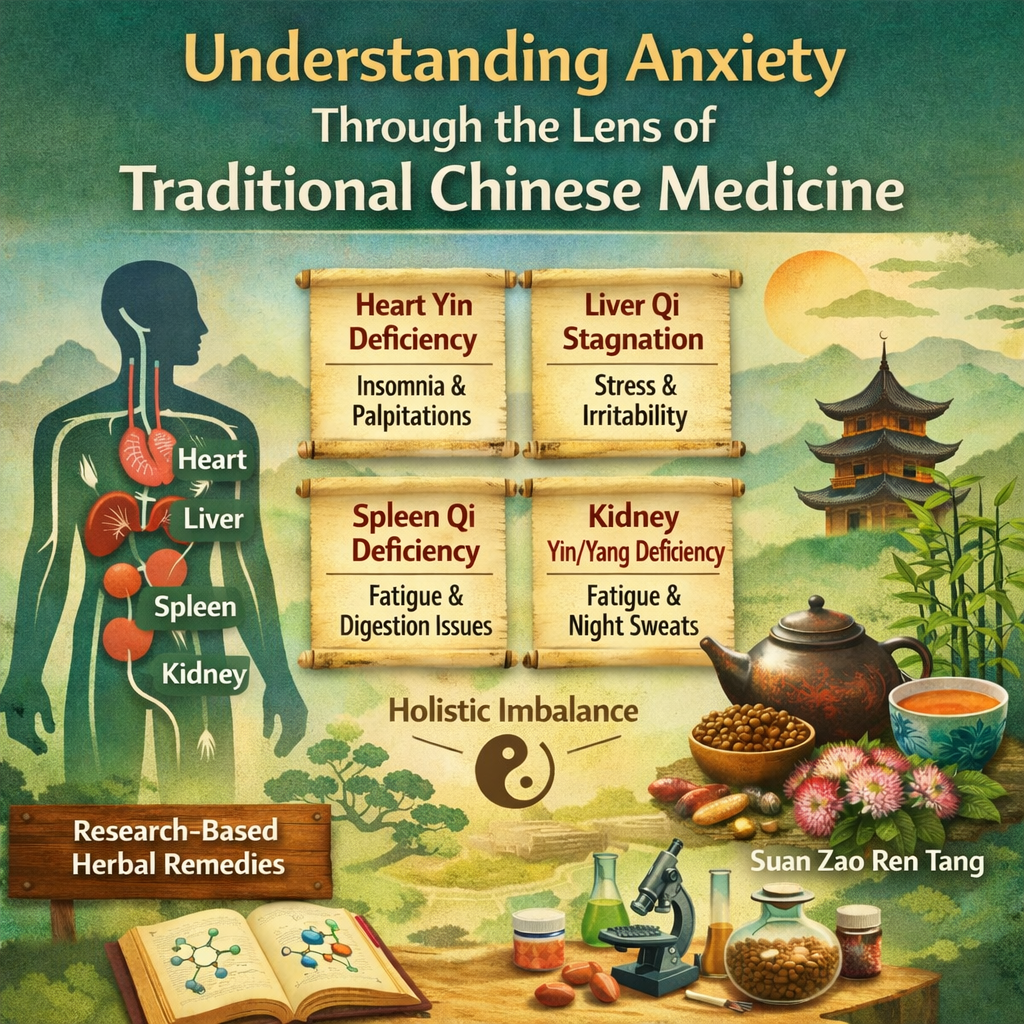
Anxiety is one of the most common psychological problems. Most conventional treatments are rooted in enhancing neurotransmitter serotonin production. Traditional Chinese Medicine (TCM) sees anxiety as oftentimes resulting from deeper physiological and energetic imbalances, which could be disharmonies of the liver, heart, and kidney, Qi flow, insufficient sleep, or stress regulation.
From this perspective, certain Chinese herbal remedies have been widely applied for the treatment of anxiety, stress, insomnia, and even depression.
Here, we summarize standard TCM patterns of anxiety and discuss what scientific research currently has to say about a few popular Chinese herbs and anxiety.
How TCM Views Anxiety?
In TCM, emotional health is inseparable from bodily functions such as sleep, digestion, and energy circulation. Instead of viewing anxiety as a unitary condition, TCM generally categorizes it into “patterns,” which are representative of specific types of internal disharmony.
Common TCM Patterns Associated with Anxiety
Heart Yin Deficiency: Symptoms include insomnia, palpitations, restlessness, and a racing mind. When “Yin” (nourishing, cooling) is deficient, the mind/spirit (Shen) becomes hyperactive.
People with this pattern tend to overthinking, may have a red tip of the tongue, and experience shortened sleep.
Liver Qi Stagnation: This pattern usually results from long-term stress, repressed anger, and emotional strain. Symptoms include irritability, moodiness, tightness in the chest, or tenseness along the side of the body where the Liver Channel is distributed.
People may experience a bitter taste or abnormal liver function.
Spleen Qi Deficiency: This pattern can come from excessive worry and overthinking. It may manifest as fatigue, poor digestion, heaviness, and mental churn.
When digestion is compromised, nutrients cannot be processed efficiently. The nervous system becomes hyperactive in response to stress or stimulation. Healthy gut lining is a key factor in treating anxiety. That is why many formulas for anxiety, depression, or allergies include herbs to improve gut health.
This is also why functional doctors often connect leaky gut with various conditions, including joint pain, heart problems, or ED.
Kidney Deficiency of Yin/Yang: This pattern may result from ongoing stress, overworking, or emotional exhaustion. Signs may include tiredness, fatigue, anxiety, frequent night urination, or ED.
For women, this pattern may present as lower back pain, osteoporosis, or osteopenia, particularly near menopause.
Individualized Treatment in TCM
Being able to recognize these patterns enables a trained TCM practitioner to select specific herbal formulas rather than a “one-size-fits-all” approach. Chinese herbal formulas target different organs such as the gut, liver, spleen, and heart.
These formulas are not addictive. Patients must make an effort to drink them, but they often feel better after doing so. If someone rarely eats vegetables or drinks herbal tea, the body may need time to produce the right enzymes to digest herbal formulas.
What Research Reveals: Chinese Herbs for Anxiety Supported by Evidence
Below are some Chinese herbal formulas commonly used for anxiety or related stress and sleep issues, along with a summary of the best available scientific evidence.
Xiao Yao San (XYS)
A meta-analysis published in 2023 reviewed 14 randomized controlled trials (RCTs) with a total of 1,256 participants (645 treated with traditional Chinese medicine and 611 given conventional treatments). The results showed that XYS, either alone or combined with conventional anxiolytics, was superior to conventional anxiolytics alone.
In studies where XYS was prescribed as monotherapy (not combined with Western anxiolytics), response rates were more favorable compared to anti-anxiety medication alone.
This suggests that XYS may be effective for anxiety associated with mood swings, leaky gut, high stress, and liver-related dysfunction.
Suan Zao Ren Tang (SZRT), Often Combined With Zhi Zi Chi Tang
In a multicenter, randomized, controlled trial involving insomnia combined with anxiety (119 patients in each group), a four-week SZRT-based treatment was superior to control treatments in improving sleep quality, insomnia severity, and anxiety scores.
For individuals whose anxiety is closely tied to sleep disruption, SZRT may offer dual benefits by calming the mind and improving sleep. When sleep is insufficient or shallow, happy hormone production decreases, and the nervous system becomes imbalanced, affecting emotional perception.
Albizia Julibrissin (He Huan Pi – “Tree of Happiness”)
Rodent studies show that ethanolic extracts of Albizia Julibrissin bark produce anxiolytic-like effects. Treated rats spent significantly more time exploring the open arms of the elevated plus-maze, a standard animal model for anxiety.
In a randomized parallel-controlled trial, isolated Albizia compound Julibroside C1 demonstrated anxiolytic-like activity comparable to diazepam. This effect was blocked by both 5-HT1A and GABA receptor antagonists, indicating that the anti-anxiety effect depends on serotonin and GABA pathways.
These findings suggest that Albizia may support emotional regulation through serotonergic and GABAergic mechanisms.
Conclusion
For individuals interested in TCM herbal support for anxiety—especially when stress is associated with mood swings, leaky gut, or insomnia—Xiao Yao San and Suan Zao Ren Tang currently have the strongest research support.
Because TCM treatment is individualized, it is important to consult a certified practitioner rather than self-prescribing, especially when other health conditions or medications are involved. Long-term use of single herbs may also lead to imbalances.
Reference:
Wang Y, Chen X, Wei W, Ding Y, Guo R, Xing J, Wang J. Efficacy and safety of the Chinese herbal medicine Xiao Yao San for treating anxiety: a systematic review with meta-analysis and trial sequential analysis. Front Pharmacol. 2023 Oct 12;14:1169292. doi: 10.3389/fphar.2023.1169292. PMID: 37905203; PMCID: PMC10613521.
Hu LL, Zhang X, Liu WJ, Li M, Zhang YH. Suan Zao Ren Tang in combination with Zhi Zi Chi Tang as a treatment protocol for insomniacs with anxiety: a randomized parallel-controlled trial. Evid Based Complement Alternat Med. 2015; 2015:913252. doi: 10.1155/2015/913252. Epub 2015 Feb 22. PMID: 25793006; PMCID: PMC4352487.
Hu J, Teng J, Wang W, Yang N, Tian H, Zhang W, Peng X, Zhang J. Clinical efficacy and safety of traditional Chinese medicine Xiao Yao San in insomnia combined with anxiety. Medicine (Baltimore). 2021 Oct 29;100(43):e27608. doi: 10.1097/MD.0000000000027608. PMID: 34713840; PMCID: PMC8556059.
Li M, Liu X, Ye X, Zhuang L. Efficacy of acupuncture for generalized anxiety disorder: A PRISMA-compliant systematic review and meta-analysis. Medicine (Baltimore). 2022 Dec 9;101(49):e30076. doi: 10.1097/MD.0000000000030076. PMID: 36626458; PMCID: PMC9750622.