
How can Astragalus Protect Kidney Function?
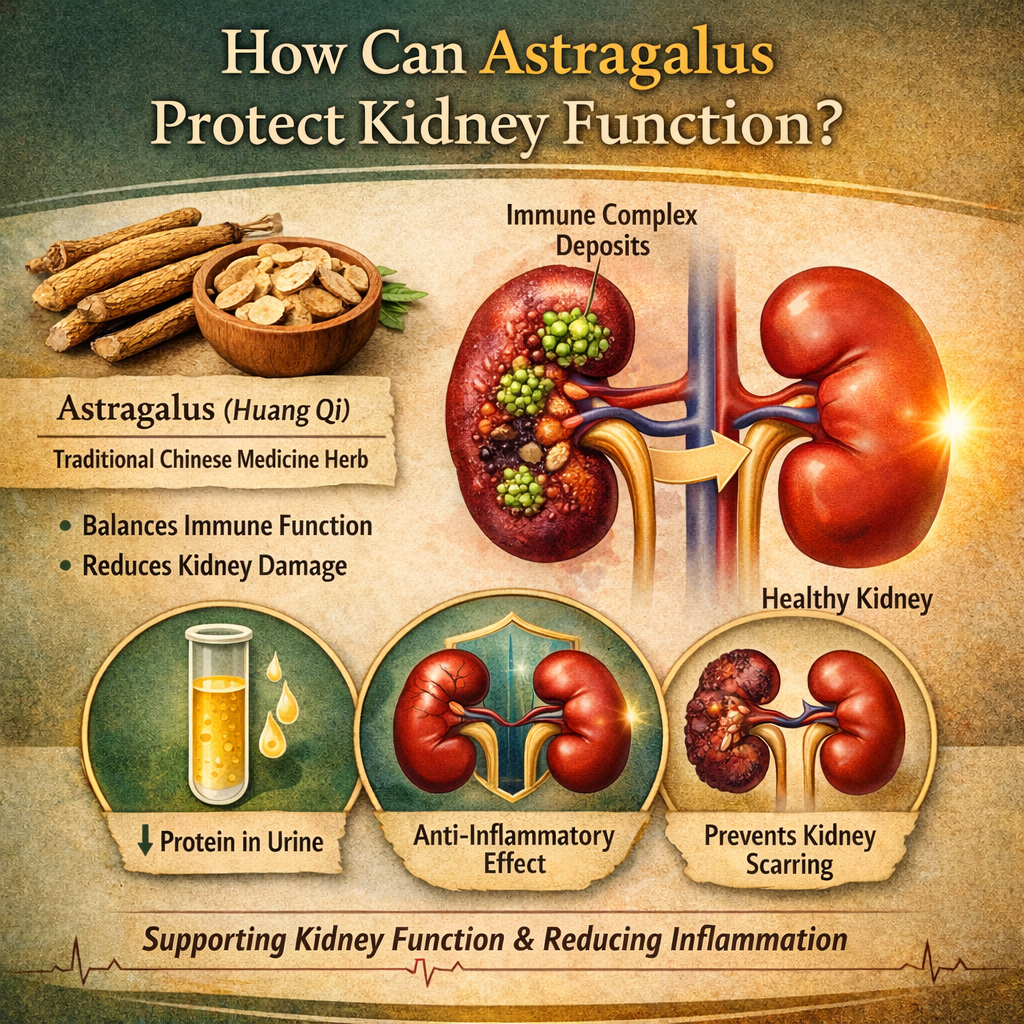
Kidney failure or chronic kidney disease (CKD) is a pressing health concern because of environmental toxins, long-term medication usage, and dehydration; some herbs have been shown to enhance the efficiency of the kidneys. In modern society, with all the stimulation to our nervous system, the immune system tends to produce antibodies to attack the kidneys or other organs. Idiopathic membranous nephropathy is an autoimmune kidney problem. The pathology report showed immune complex deposits on the subepithelia in the kidney. Antibodies against phospholipase A2 receptors were detected in 70 to 80% of patients. Immunosuppressive therapy has been a routine therapy, which can only work for some people. Thirty percent of people have poor responses to this therapy, which has a high cost and an increased infection rate. Astragalus has been shown to have protective effects in the kidney by balancing immune function.
Astragalus (Huang Qi)
Botanical name: Astragalus membranaceus
Astragalus is one of the most commonly used herbs in Traditional Chinese Medicine (TCM) and has been used to strengthen Qi and support kidney and lung function for many centuries. It is becoming more and more common in treating allergies and autoimmune diseases in modern society. A new review study published in Medicine in 2023 reviewed 50 randomized controlled trials involving 3,423 patients to evaluate Astragalus’s effect in protecting kidney function. In the review study, researchers compared the group that combined an Astragalus herbal formula with immunosuppressive therapy and the group that received only immunosuppressive therapy. The results indicated that the herbal formula combined with immunosuppressive therapy had better results than immunosuppressive therapy alone. The complete response rate and partial response rate were much higher in the group combined with the herbal formula. Serum albumin, protein in the urine, and serum creatinine levels were much lower in the combined group. Research suggests that Astragalus can decrease the amount of protein in the urine, a major sign of kidney damage, and deliver anti-fibrotic effects that may delay kidney scarring. It also reduces oxidative stress and inflammation on the walls of the kidney, both of which can compromise kidney function silently.
- Wang D, Wang; Zhang M, Li P, Zhang, Q, Bao K Astragalus membranaceus formula for moderate-high risk idiopathic membranous nephropathy: A meta-analysis. Medicine 102(9):p e32918, March 03, 2023. | DOI: 10.1097/MD.0000000000032918
- Lui SL, Zhu D, Cheng SW, et al. Effects of Astragalus membranaceus-based Chinese Medicine Formulae on Residual Renal Function in Patients on Peritoneal Dialysis. Peritoneal Dialysis International: Journal of the International Society for Peritoneal Dialysis. 2015;35(5):595-597. doi:10.3747/pdi.2014.00039
- Lei X, Zhang L, Li Z, et al. Astragaloside IV/lncRNA-TUG1/TRAF5 signaling pathway participates in podocyte apoptosis of diabetic nephropathy rats. Drug Des Devel Ther. 2018;12:2785–93. [22]
- Lei X, Zhang BD, Ren JG, et al. Astragaloside suppresses apoptosis of the podocytes in rats with diabetic nephropathy via miR-378/TRAF5 signaling pathway. Life Sci. 2018;206:77–83. [23]
- Guo H, Wang Y, Zhang X, et al. Astragaloside IV protects against podocyte injury via SERCA2-dependent ER stress reduction and AMPKα-regulated autophagy induction in streptozotocin-induced diabetic nephropathy. Sci Rep. 2017;7:6852.